
Research Shows Results
Opportunity Culture® teams lead to strong student learning gains, research shows
What do third-party research and learning growth data show about the effects of Opportunity Culture® staffing design and teaching teams? Read on, or use the “jump to” links to quickly navigate the details. And see our Results page for more charts and information.
Summary: Research Findings
Extra half-year of learning
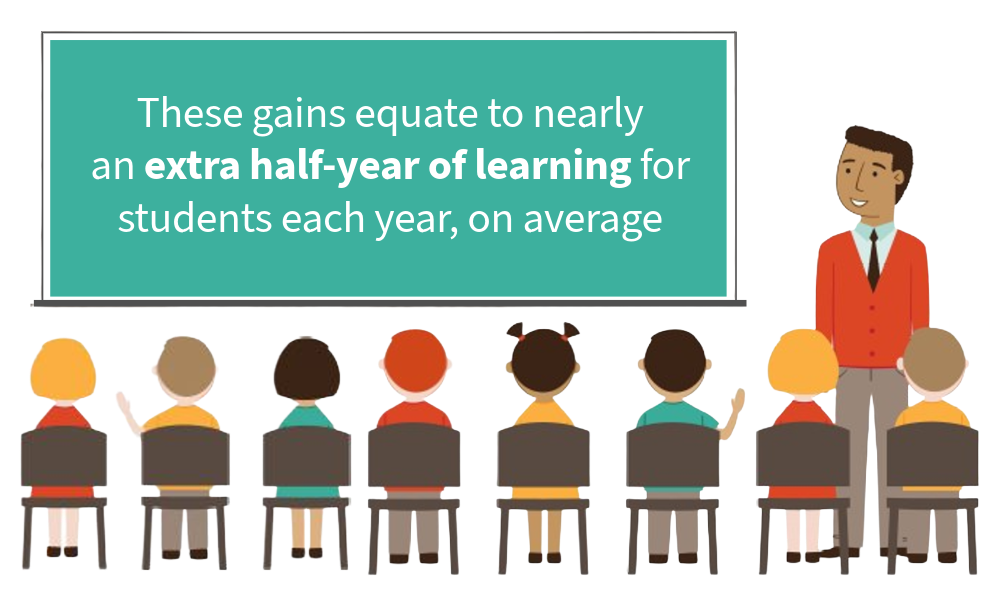
In 2013–2016 and 2020–2024: Students taught by teachers on Opportunity Culture® (OC®) teams gained nearly an extra half-year of learning growth in math and reading, on average, in two third-party studies of four districts covering seven years. Students in the same schools but not taught by these teams learned almost an extra month more, too, according to the second study. All schools in these studies went through Opportunity Culture® design based on research—but before creation of OC® standards based on initiative data.
2–3X the rate of schoolwide high-growth learning
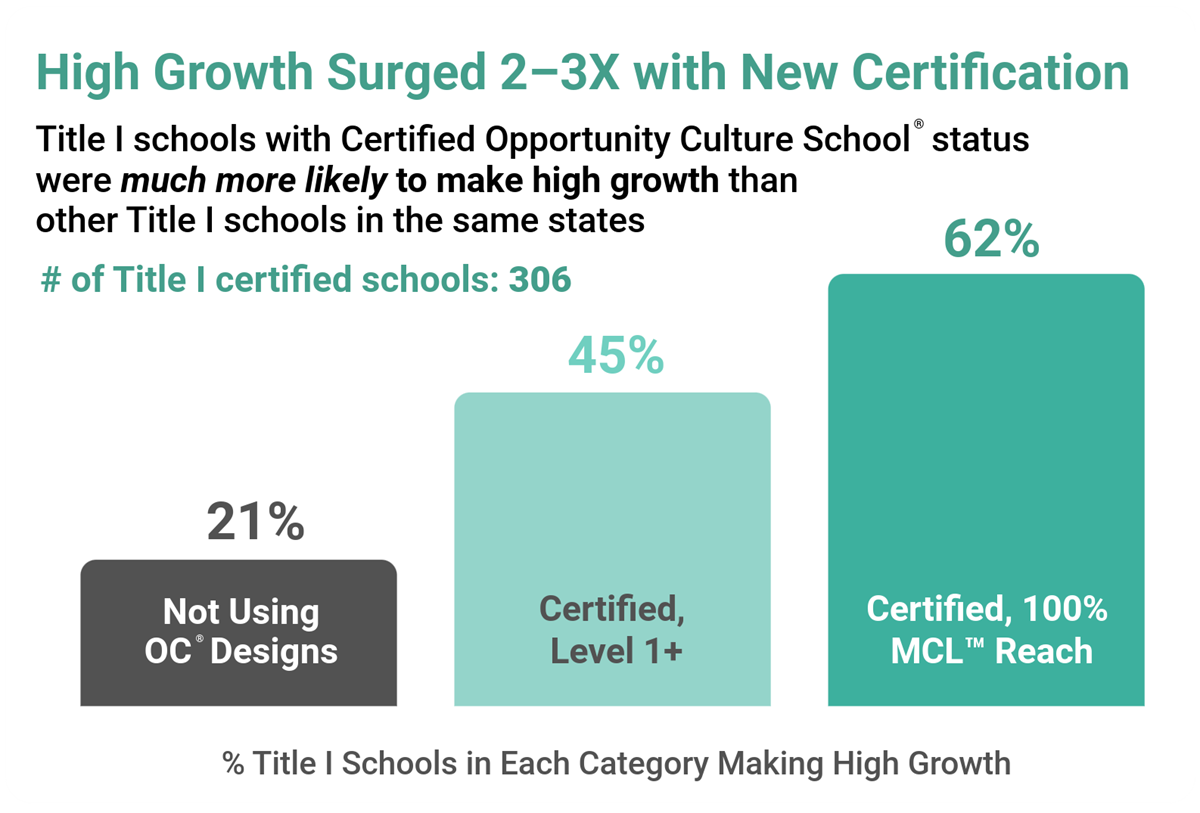
In 2024–25, among hundreds of Title I schools, 45% of Title I schools meeting Level 1 certification standards for Opportunity Culture® teams made high growth, compared with just 21% of U.S. Title I schools without OC® teams. 62% with these teams produced high-growth learning schoolwide when they met Opportunity Culture® design standards for all of their students. Increasing fidelity increased rates of high-growth learning even more.
The Considerations:
- Third-party research so far covers implementation only through 2023–24.
- Schoolwide student learning growth analysis is based on publicly available data from 2024–25.
- The Opportunity Culture® initiative correlates design elements with student learning to create data-driven design standards for certification. In 2024–25, Public Impact® introduced design certification standards based on data from the prior decade.
- Schools may obtain Certified Opportunity Culture® School status at the provisional level with an implementation plan or partial implementation, and then at Levels 1, 2, or 3 for meeting increasingly high standards.
- To receive Certified Opportunity Culture School® status, schools must legally attest to using current design standards. Schools not attesting that they used OC® design standards have not achieved the same positive learning outcomes, on average.
- No third-party analysis has yet been published on the higher design standards; schoolwide student learning growth data indicates stronger results among schools meeting the higher design standards.
- The Opportunity Culture® initiative uses data from third-party research and other analyses to improve. For example, the blended-learning school model is no longer recommended, because results were too low to meet the initiative’s high-growth standard.
Third-Party Research Findings
Two independent studies have analyzed the student learning effects of Opportunity Culture® designs, collectively covering seven school years in four school systems in three states, with tens of thousands of student observations. Both studies used advanced statistical methods to compare student learning growth in classrooms served by Opportunity Culture® teams to growth in other classrooms in the same and other schools.
The studies—one from AIR and Brookings and the other from Texas Tech University—found that students gained nearly an extra half-year of learning each year when their teachers were on Multi-Classroom Leader® (MCL™) teams, averaging across the studies for reading and math, and applying the method of researchers from Stanford, Harvard, and other institutions* to convert effects into years and months of learning.
These teams are led by an MCL™ educator with prior high-growth student learning and include a variety of team teacher and paraprofessional roles. Some MCL™ teams in these studies had teachers in the Team Reach Teacher™ role, which lets teachers reach more students directly or through a leadership role on the team, such as mentoring a new teacher or resident. In the Texas study (described below), researchers also found that by the third year of implementation in a school, students not taught directly by these teams made an extra 0.8 months (~3.5 weeks) of annual learning growth, a “spillover effect” not explored in the AIR-Brookings study.
Interpretation Note:
In teams studied, as is typical in Opportunity Culture® design, Multi-Classroom Leader® educators shared accountability for student learning with their team teachers, though formality of accountability varies across sites. Many MCL™ educators have a partial-release role, continuing to teach their own students of record. Researchers studied effects on their students of record and, separately, students for whom MCL™ team teachers were the primary teacher of record. The combined weighted average of these two effects represents the total “treatment” effect; these calculations are an estimation by Public Impact, not the original researchers.
AIR-Brookings Study for the CALDER Center
The 2018 AIR-Brookings evaluation compared student learning in classrooms taught by Opportunity Culture® teams to other classrooms. Students of teachers on MCL™ teams showed sizable, statistically significant academic gains:

Students in MCL™ educators’ own classrooms made 6–13 months more growth annually than teachers not on OC® teams:
- Reading: An extra 3–7 months of learning annually
- Math: An extra 6–13 months of learning annually.

Students whose teachers were members of MCL™ teams made 2–4 months more growth annually:
- Reading: An extra 2–3 months of learning annually
- Math: An extra 4–6 months of learning annually.
Interpretation Notes:
All seven of seven statistical models in math found a statistically significant positive effect.
Even though six of seven statistical models in reading found a statistically significant positive effect in reading, the authors concluded that the one model that did not—which assumed no spillover effects on students outside of OC® teams—was the most valid. They did not attempt to measure spillover quantitatively and were not funded to examine potential spillover-causing actions.
We cannot say what effects they would have found if attempting to measure spillover quantitatively. Recorded interviews that Public Impact conducted before this study—during the years of implementation studied—revealed potential spillover activities, however, including hundreds of excess applicants for advanced roles placed as teachers in the same schools, and sharing of materials and coaching outside the MCL™ teams in the same schools.
Texas Study
In 2026, Texas Tech University Associate Professor Jacob Kirksey and colleagues released a four-year study of OC® implementation in Ector County (Texas) Independent School District, comparing students taught by teachers on OC® teams with those whose teachers were not on OC® teams. The study’s findings:
Students in MCL™ educators’ own classrooms made 6–13 months more growth annually than teachers not on OC® teams:
- Reading: An extra 6–13 months of learning annually
- Math: An extra 6–9 months of learning annually.
Students whose teachers were members of MCL™ teams made 2–4 months more growth annually:
- Reading: An extra 3–4 months of learning annually
- Math: An extra 2 months of learning annually.

In schools using MCL™ teams, benefits spilled over to students whose teachers were not on MCL™ teams
- Student growth increased more rapidly among teachers in OC® schools who were not on OC® teams than among teachers in schools without OC® models.
- By the third year of implementation, this increased growth was adding an extra 0.8 months (about 3.5 weeks) of learning for these teachers’ students annually.

The Texas Tech researchers also conducted interviews with 28 people in the MCL® role to understand the roles and other related changes.
Interpretation Notes:
The reading gains in this study are substantial, equal to about half the annual gain in reading students received during Mississippi’s surge in reading performance; the direct effect of Opportunity Culture® models is three times the size of the Mississippi effect.
Using the study’s spillover figures, a student attending schools with OC® teams throughout their K–12 years who somehow never had an OC® teacher would exit 12th grade with over a year of extra learning growth simply from attending schools with OC® teams.
*In this method, 0.25 standard deviations = 1 nine-month year of learning. See: The MET Project (2012, January). Gathering Feedback for Teaching Combining High-Quality Observations with Student Surveys and Achievement Gains.
Retrieved from https://cepr.harvard.edu/sites/g/files/omnuum9881/files/cepr/files/met_gathering_feedback_practioner_brief_0.pdf; and Hanushek, E., Peterson, P., & Woessmann, L. (2012, Fall). Is the U.S. Catching Up? International and State Trends in Student Achievement. Education Next.
Retrieved from http://hanushek.stanford.edu/sites/default/files/publications/Hanushek%2BPeterson%2BWoessmann%202012%20EdNext%2012%284%29.pdf.
The Opportunity Culture® initiative meets ESSA requirements for an evidence-based intervention for schools in need of improvement.
Schoolwide Learning Growth Findings
Each year, Public Impact analyzes publicly available data from state websites on schoolwide student learning growth, placing schools into categories: high growth (top 25% in the state), low growth (bottom 25%) and typical growth (in between top and bottom). In 2024-25, data from about 580 schools using Opportunity Culture® models was available, spanning 40 school districts in seven states. We also gathered data on more than 20,000 schools not using OC® models in these states.
Since 88% of schools using Opportunity Culture® models are Title I schools, most of our comparisons focus on Title I. In states using the models, 21% of Title I schools with no OC® teams had schoolwide high growth. In contrast, Title I schools with OC® teams had the following rates of schoolwide high growth:
If certifying at Level 1+:
45% rate of schoolwide high growth in reading and math combined.
If reaching 100% of students in at least one core subject:
62% rate of schoolwide high growth in reading and math combined (certified at any level; 67% if Level 1+).
Increasing fidelity on more individual certification elements boosted rates of high-growth learning even more than rates reported here.
All individual certification elements were also associated with higher-growth learning, except the highest pay; higher pay, however, has been associated with higher educator satisfaction.
Lessons: Analysis of Design Elements Associated with Learning & Educator Satisfaction
The certification standards were chosen based on over a decade of data analysis correlating design and implementation factors with schoolwide student learning growth. It is thus not surprising that schools with certification were much more likely than other schools to make high growth when they met the whole package of certification standards, including, among others:
- Reaching higher percentages of students
- MCL™ role selectivity—aiming for top-25% student learning compared to others in state or nation
- Higher pay, sustainably funded
- Ample protected time for collaboration and leadership
- Joint accountability between teacher-leaders and their teams, and
- Communication within the school about the roles and models.
Schoolwide high-growth learning was also more likely when schools implemented all three pillars of Opportunity Culture® design. Schools were much more likely to make schoolwide high growth when they:
- Reached 100% of students with MCL™ teams. Certified Title I schools reaching 100% of students with MCL™ teams were three times more likely to make schoolwide high growth than Title I schools without the models.
- Used Team Reach™ models to add roles beyond the MCL™ role, including paying other teachers more to extend reach and adding advanced paraprofessional positions.
- Met Level 2 or 3 standards for tutoring culture—weekly time for all students using lessons aligned with the curriculum and addressing students’ needs, based on data, including prerequisite, on-standard, and advanced lessons.
Schools have many avenues to boost learning beyond the percentages reported here, first and foremost by reaching more students in all four core subjects across all grades. Using classroom vacancy trades was associated with even higher rates of schoolwide learning growth than reported here when combined with Team Reach models, which freed funds to boost pay for more educators and add more MCL™ roles, allowing coverage of more grades and subjects.